Briefing
Catalina Island UFO Files: What Pentagon Records Show
Executive Summary
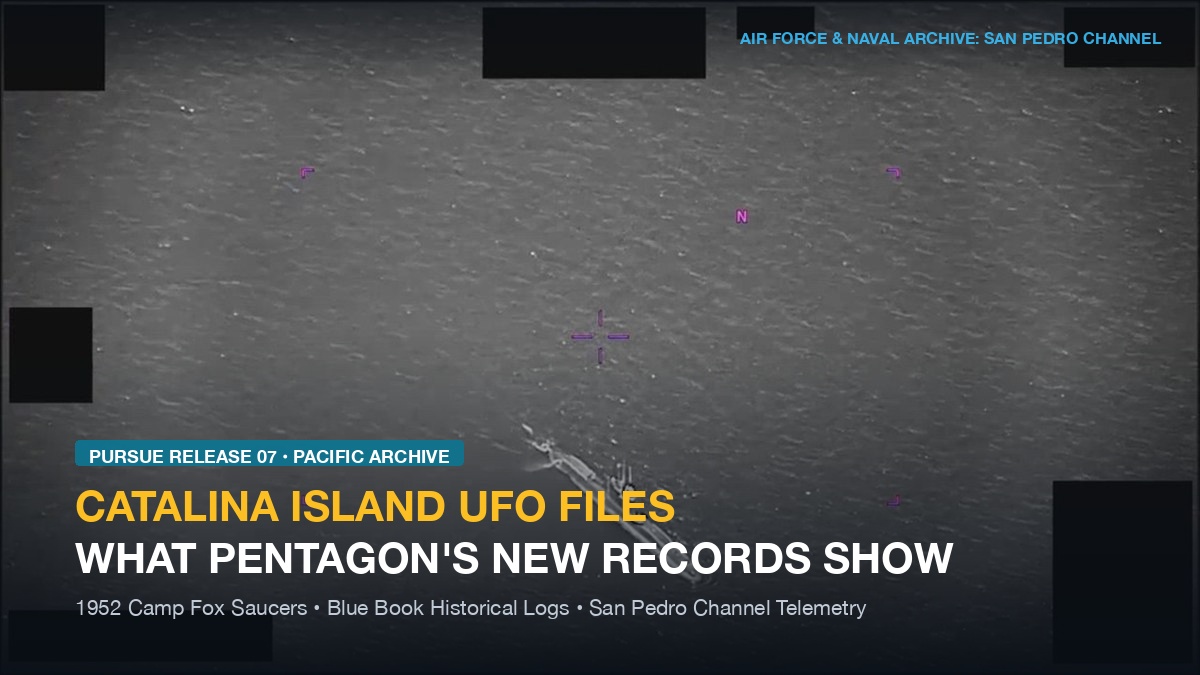
Among the newly declassified records in the Pentagon’s October 2026 PURSUE Release 07 are four unsealed historical Air Force investigation files documenting recurring unidentified aerial encounters over Southern California’s Catalina Island. From the August 1952 Camp Fox Boy Scout report of climbing silver saucers outracing jet interceptors to November 1953 hovering purplish-white craft, we examine what Air Force investigators logged, where explanations held up, and why the San Pedro Channel remains central to naval anomalous tracking.
What the newly unsealed California records actually document
Catalina Island and the surrounding deep-water oceanic trenches of the San Pedro Channel have occupied a prominent role in military folklore and maritime UAP research for over seven decades. The unsealing of four dedicated historical case dossiers in PURSUE Release 07 provides the first official, unredacted Project Blue Book investigative summaries evaluating witness credibility, visual angles, and atmospheric conditions off the Southern California coast.
The Unsealing: 4 Historical Case Files in Release 07
While Release 07 generated worldwide attention for modern military black triangle telemetry, the tranche also unsealed declassified historical dossiers specifically focusing on coastal California aerospace incursions between 1948 and 1955.
- The documents originated within Air Technical Intelligence Center (ATIC) records and Project Blue Book investigative files at Wright-Patterson Air Force Base.
- Each report documents multi-witness visual sightings over the island, formal witness interview transcripts, and local weather radar correlation notes.
- The records highlight military concern regarding potential foreign aerial reconnaissance over the strategically vital Long Beach and San Diego naval corridors.
August 1952: The Camp Fox "Silver Flying Saucer" Report
The most prominent case file involves an August 1952 incident reported by three Boy Scouts and staff counselors stationed at Camp Fox, located in a secluded cove along Catalina’s coast.
- Witnesses reported observing multiple metallic, silver saucer-shaped objects executing a sharp, coordinated climbing turn above the island ridges.
- Interview debriefs note that the objects moved without audible engine noise and accelerated at speeds significantly exceeding contemporary jet aircraft.
- Air Force investigators interviewed the witnesses and evaluated whether the objects could be explained by naval gunnery practice or aerial flares, ultimately listing the incident as an evaluated observation.
November 1953: The Hovering Purplish-White Craft
A separate November 1953 memorandum details a high-altitude observation over Avalon witnessed by civilian observers and verified by coastal air defense radar.
- Witnesses described a stationary, round, luminous purplish-white object hovering motionlessly for several minutes before accelerating northwest toward mainland Los Angeles.
- Coastal radar stations logged intermittent returns with no transponder handshake during the encounter window.
- The unsealed record contains technical analysis ruling out weather balloons due to contrary high-altitude wind directions recorded that morning.
The Pacific USO Connection & Modern Navy Telemetry
The unsealing of the Catalina Island records connects historical Cold War airspace reports with modern naval sensor encounters in the Southern California Operating Area (SOCAL).
- The San Pedro Channel reaches ocean depths exceeding 3,000 feet, historically attracting civilian rumors of submerged transmedium craft (USOs).
- Modern Navy sensor recordings—including the 2004 USS Nimitz encounter and 2019 carrier strike group thermal clips—took place in adjacent Pacific training sectors.
- Defense analysts note that while historical reports lack the electronic telemetry of modern FLIR pods, their spatial clustering mirrors ongoing military monitoring zones.
Key takeaways from the Catalina Island file unsealing
- PURSUE Release 07 unseals four formal Air Force historical files investigating flying saucer reports over Catalina Island.
- The 1952 Camp Fox incident and 1953 Avalon encounter provide rare primary-source documentation of civilian and military witness evaluations.
- Air Force evaluators carefully considered conventional explanations (meteors, flares, balloons) while acknowledging anomalous maneuverability in specific witness cases.
- The records illustrate that military interest in the Southern California coastal corridor spans over 70 years of continuous documentation.
Read next
- PURSUE Release 07 black triangle briefing - analysis of the modern hypersonic craft logs unsealed in the same tranche
- Project Blue Book archive analysis - how the Air Force investigated 12,618 historical sightings
- PURSUE Release 07 master hub - complete directory of the 28 newly declassified documents
- Pacific coastal radar map - visualize Pacific naval encounters on the active radar grid
How to evaluate historical witness accounts alongside Project Blue Book evaluations
The strongest reading starts with the primary record, then follows the supporting documents, dates, agency labels, and public statements around it. When commentary or reporting adds context, it is weighed against the source record instead of being treated as the record itself.