Briefing
Chicago O'Hare UFO at 20: Gate C17 Hole-Punch Disc & FAA Audio
Executive Summary
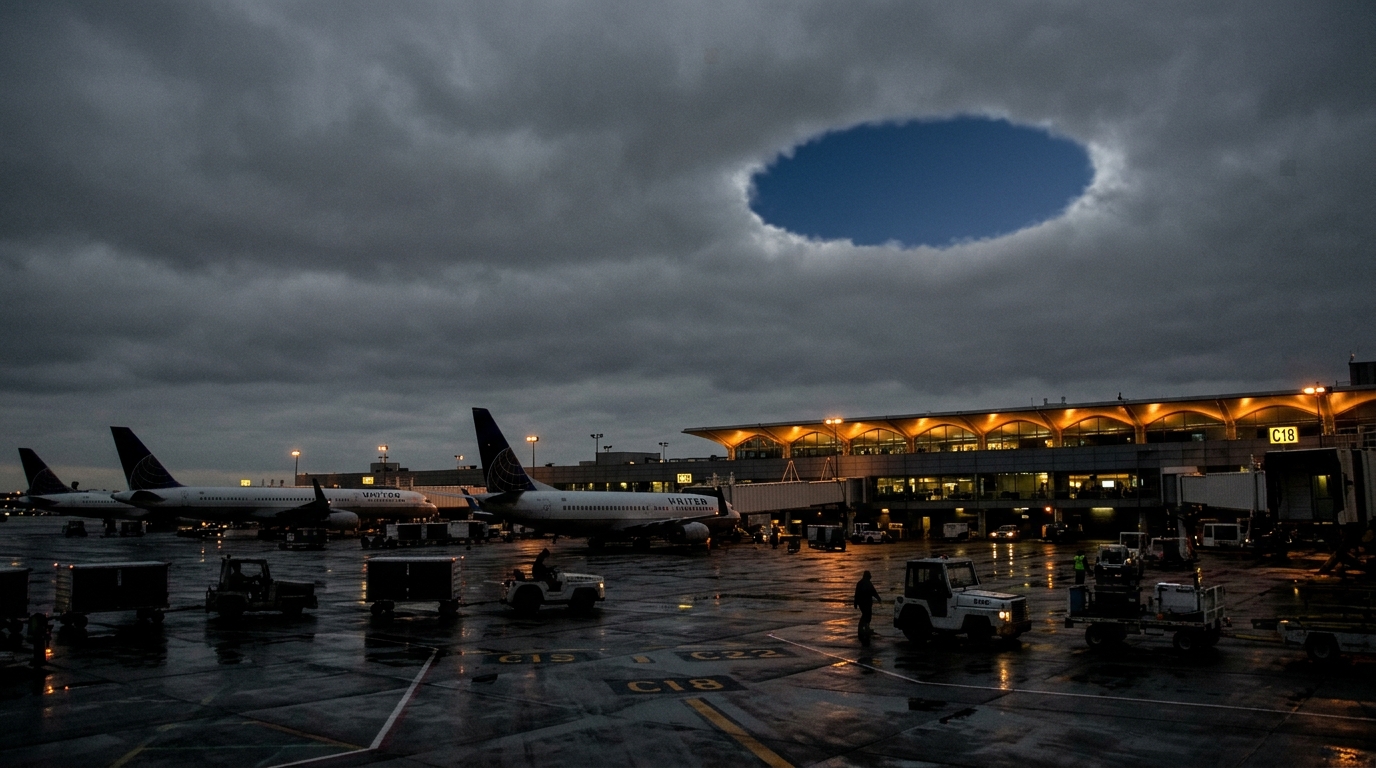
November 7–8, 2026 marks the exact twentieth anniversary of one of the most credible mass-witness commercial aviation encounters in modern history: the Chicago O'Hare International Airport UFO incident. At approximately 4:15 p.m. CST on November 7, 2006, more than a dozen United Airlines ramp mechanics, ground crew supervisors, and flight deck personnel watched a dark metallic saucer-shaped craft silently hover directly over Concourse C, Gate C17. For several minutes, the metallic disc hovered motionless beneath a 1,900-foot solid overcast cloud layer before shooting vertically upward at extreme velocity, punching a crisp, circular hole through the cloud deck that remained open for nearly fifteen minutes. While the Federal Aviation Administration initially denied having any records and later dismissed the event as a rare meteorological "hole-punch cloud," investigative Freedom of Information Act disclosures by the Chicago Tribune and independent analysis by NARCAP revealed recorded FAA air traffic control communications confirming airport managers were tracking the object in real time.
Aviation Radar & Federal Coverup Protocols
The official player loads only after selection. The source link remains available for direct verification.
What to know
Unsealed FAA audio tapes obtained under FOIA proved that United Airlines operational supervisors repeatedly contacted the FAA control tower during the event, asking controllers if they could visually track the disc above Gate C17. The comprehensive technical study published by the National Aviation Reporting Center on Anomalous Phenomena (NARCAP Report 10) demonstrated that the atmospheric conditions at O'Hare on that afternoon precluded the formation of natural fallstreak or hole-punch clouds, leaving the physical disturbance of the cloud deck as empirical evidence of an anomalous propulsion signature.
The Gate C17 Sighting: United Airlines Flight 446 Pushback
The incident unfolded during peak afternoon ground operations at Terminal 1 as United Airlines Flight 446 prepared for departure.
- Eyewitness Pushback Crew: A United Airlines ramp mechanic pushing back Flight 446 to Charlotte was the first to look up and spot the elliptical, spinning metallic craft hovering silently between 1,400 and 1,900 feet.
- Flight Crew Confirmation: The ramp worker immediately alerted the captain and first officer in the cockpit of Flight 446, who opened their side cockpit windows to visually verify the craft.
- Physical Geometry: Multiple witnesses described a completely silent, dark gray or dull gunmetal disc estimated between 22 and 88 feet in diameter, exhibiting no vapor trails, exhaust plumes, navigation strobes, or aerodynamic control surfaces.
The Vertical Departure & The Cloud Punch Anomaly
After remaining motionless above the terminal gate for approximately five minutes, the vehicle executed an instantaneous non-inertial maneuver.
- Extreme Vertical Acceleration: Without tilting, tilting rotors, or sound, the craft accelerated straight upward into the overcast stratus cloud layer at supersonic velocity.
- The Clear Cloud Punch: As the disc pierced the overcast, it left a sharp, circular hole corresponding to its diameter, through which observers on the tarmac could see blue sky above the dense autumn cloud layer.
- Atmospheric Longevity: The hole remained open with crisp borders for over ten minutes before surrounding cloud moisture gradually diffused back across the opening.
The FOIA Trail: Jon Hilkevitch and the FAA Audio Tapes
Official agencies initially claimed no incident occurred, until investigative reporting forced the release of tower audio.
- Initial Denials: United Airlines management and the FAA initially told journalists that zero reports existed and that no controllers had received calls.
- The Chicago Tribune Investigation: Reporter Jon Hilkevitch filed targeted federal records requests, forcing the FAA to review tower voice loops.
- The Recorded Tower Call: Unsealed audio captured a United coordinator asking the control tower coordinator, "Did you see a flying disc out by C17?" to which the tower specialist responded that controllers were discussing the sighting.
NARCAP Report 10 vs the Weather Phenomenon Debunk
The FAA's subsequent claim that the event was a "weather phenomenon" or optical illusion was systematically dismantled by atmospheric physicists.
- Absence of Supercooled Moisture: NARCAP's 155-page technical investigation verified that ambient temperatures and moisture content at 1,900 feet were entirely incapable of producing a natural ice-crystal fallstreak.
- Directed Energy Signature: Atmospheric researchers noted that ionizing radiation, high-energy RF microwave emission, or thermal displacement from an anomalous drive field would cleanly vaporize water droplets along the vehicle's ascent path.
- Modern Integration into War.gov: Two decades later, the O'Hare case remains a foundational baseline in federal aviation anomaly reporting standards adopted by AARO and international aviation authorities.
What to take from it
- The 2006 Chicago O'Hare encounter remains one of the most thoroughly witnessed commercial airport UAP events in history.
- United Airlines pilots, mechanics, and ramp supervisors observed a metallic disc hovering silently over Gate C17 before shooting straight up.
- The craft punched a distinct circular hole through the cloud deck that remained visible for over ten minutes.
- FOIA requests uncovered FAA air traffic control audio verifying that United operations supervisors contacted the tower in real time.
- Scientific analysis by NARCAP refuted the official weather-phenomenon explanation, confirming an anomalous physical disruption.
Read next
- Commercial airline UAP near-misses briefing - FAA radar files on passenger airline close encounters
- FAA radar secrets investigation - air traffic controller records and primary radar tracking
- Bariloche Boeing 727 airport blackout dossier - unsealed international commercial aviation close encounter
- PURSUE database 480 files audit - federal archive structure and civil aviation reports
Source trail
The strongest reading starts with the primary record, then follows the supporting documents, dates, agency labels, and public statements around it. When commentary or reporting adds context, it is weighed against the source record instead of being treated as the record itself.