Briefing
New Pentagon UFO Files: What Tranche 08 Holds for Disclosure
Executive Summary
Public interest in declassified government records has reached record highs following the release of PURSUE Tranche 07, which unsealed FBI black triangle affidavits and historical radar-visual intercepts. As global searches for "new Pentagon UFO files" surge, defense intelligence analysts and congressional oversight committees are already preparing for the next scheduled declassification tranche: PURSUE Release 08. Under the statutory timelines established by the National Defense Authorization Act (NDAA) UAP Records Collection mandate, federal agencies face imminent deadlines to transfer historical and contemporary anomaly files to the National Archives (NARA). We evaluate what records are currently queued for declassification, which defense agencies face subpoena pressure, and how Tranche 08 will shape the broader disclosure trajectory.
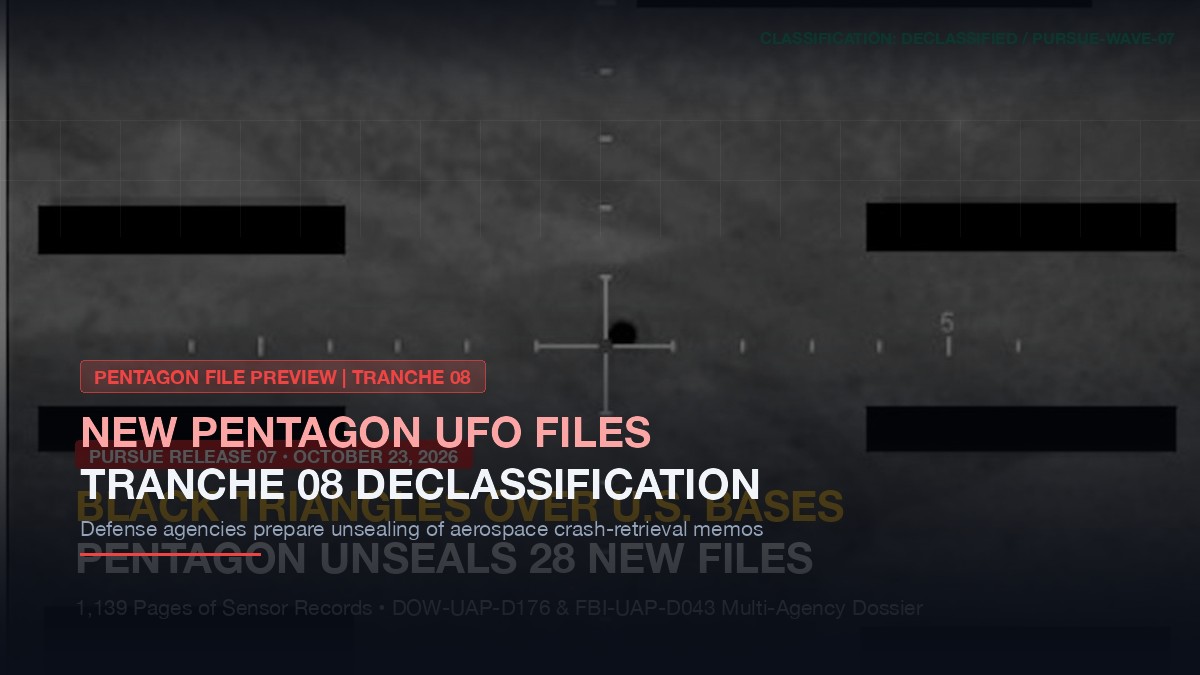
Congressional Briefing: Declassification Schedules & Oversight
The official player loads only after selection. The source link remains available for direct verification.
What defense agencies are preparing for the upcoming PURSUE Tranche 08 release
Project PURSUE—the inter-agency disclosure framework coordinated between the Department of War, the Office of the Director of National Intelligence (ODNI), and the Department of Energy (DOE)—has steadily unsealed tranches every several months. While early drops prioritized Cold War microfilm and theoretical propulsion papers, subsequent releases have incorporated high-grade operational telemetry and contractor field reports.
Statutory Declassification Mandates: The Clock on Tranche 08
Unlike discretionary public affairs releases, PURSUE tranches operate under enforceable congressional statutory directives.
- NDAA Mandatory Review: The UAP Records Collection provisions mandate that every executive agency review all records related to unidentified anomalous phenomena for presumptive public disclosure.
- Postponement Thresholds: Agencies may only postpone unsealing if they provide identifiable evidence that disclosure would compromise active human intelligence sources or weapon system technical parameters.
- Target Timeline: Congressional oversight staff project the rollout of PURSUE Release 08 to occur ahead of upcoming winter committee hearings, targeting previously restricted multi-sensor radar recordings.
Priority Files in Queue: Department of Energy and NRO Records
Intelligence insiders indicate that Tranche 08 will focus heavily on civilian and technical agencies that have historically operated outside standard military oversight.
- Department of Energy (DOE) Facilities: Following the Pantex and Sandia releases, Tranche 08 is expected to index security intrusion logs from the Nevada National Security Site and Los Alamos National Laboratory.
- National Reconnaissance Office (NRO) Telemetry: Investigators are demanding synthetic aperture radar (SAR) satellite data capturing anomalous fast-movers and trans-medium entries into upper atmospheric corridors.
- Air Force Special Operations: Decades-old flight incident reports from tactical command centers that were previously shielded under administrative exemptions.
The Fight Over Defense Contractor Vaults
The most contested boundary in the upcoming release centers on privately held aerospace contractor archives.
- Eminent Domain Language: Congressional leaders have reiterated proposals to assert government eminent domain over aerospace technologies and archival records held by defense conglomerates.
- Independent Contractor Audits: House Oversight has formally requested that the Government Accountability Office (GAO) audit historical defense contracts dating back to 1947 to verify whether public funds supported covert recovery initiatives.
- Redaction Battles: Defense legal teams are actively negotiating redaction scope for proprietary aerospace engineering drawings and telemetry formats.
Multi-Sensor Data vs. Narrative Summaries
A persistent criticism of early PURSUE tranches was the reliance on textual summaries and heavily redacted PDFs. Tranche 08 faces intense pressure to deliver raw, instrumental telemetry.
- High-Resolution Sensor Feeds: Researchers are demanding calibrated electro-optical and infrared (EO/IR) sensor streams rather than compressed preview clips.
- Simultaneous Radar Cross-Sections: Correlated data showing target radar reflectivity, altitude profiles, and doppler signatures alongside pilot communications.
- AARO Analytical Packages: Formal scientific disposition papers explaining whether investigated targets have been resolved as foreign drones, balloons, or genuinely unidentified phenomena.
How to Track and Verify New File Drops on War.gov
As release dates approach, researchers must utilize verified verification procedures to navigate authentic government portals.
- Official Repository: All authentic PURSUE releases are published directly to the War.gov/UFO federal portal and mirrored at NARA Record Group 263.
- Cryptographic Hashes: Official files include SHA-256 digital checksums to verify document integrity against unauthorized digital alterations.
- Source Cross-Referencing: Match newly unsealed tranches against existing congressional testimony and historical Project Blue Book indices to verify provenance.
Key indicators for the upcoming PURSUE Tranche 08 drop
- PURSUE Tranche 08 represents the next statutory declassification drop mandated by congressional UAP disclosure amendments.
- Anticipated focus areas include Department of Energy nuclear facility logs and NRO orbital sensor records.
- Congressional committees are increasing subpoena pressure on major aerospace defense contractors regarding proprietary archives.
- The primary demand from researchers and lawmakers is raw multi-sensor telemetry rather than redacted textual summaries.
Read next
- Pentagon Release 07 black triangles - the comprehensive breakdown of the preceding October 2026 declassification
- How to search War.gov guide - step-by-step instructions for navigating the official federal disclosure portal
- Immaculate Constellation whistleblower report - the alleged Special Access Program records under congressional scrutiny
- Release 07 master hub - complete directory of the latest 28 declassified federal records
Source trail
The strongest reading starts with the primary record, then follows the supporting documents, dates, agency labels, and public statements around it. When commentary or reporting adds context, it is weighed against the source record instead of being treated as the record itself.