Briefing
Atlantic Hypersonic Fleet: Navy Logs Vanishing Glowing Craft
Executive Summary
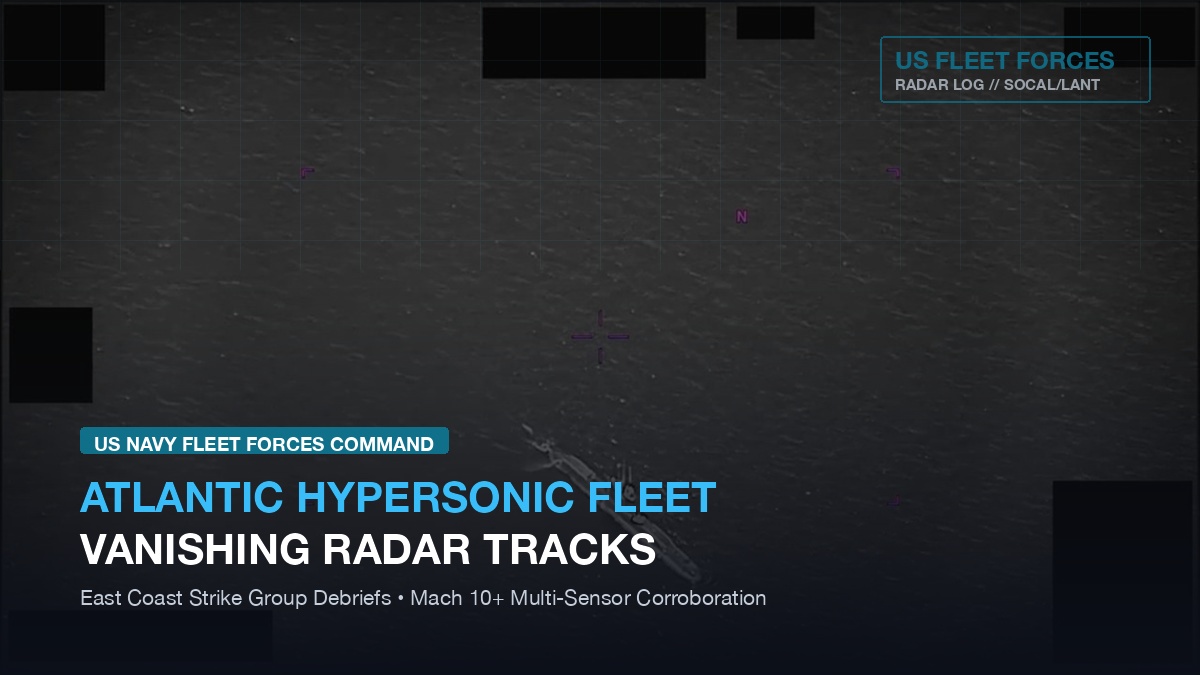
Declassified operational logs from U.S. Fleet Forces Command detail multiple dramatic encounters along the Atlantic seaboard where carrier strike groups tracked clusters of luminous, spherical aerial objects maneuvering at extreme hypersonic velocities. According to deck watchstanders and Aegis radar operators, the objects repeatedly vanished from visual and infrared thermal scopes only to instantly reappear tens of miles away on primary radar sweeps without generating sonic booms or thermal signatures.
The Atlantic fleet encounter and multi-sensor radar tracking logs
While historical naval encounters often involved solitary targets, the unsealed Atlantic Fleet logs document coordinated multi-vehicle formations operating within warning area W-72 off the coast of Virginia and North Carolina. The documents include unredacted combat information center (CIC) logs and pilot debrief extracts.
The Atlantic Encounter: Warning Area W-72
During advanced composite training unit exercises (COMPTUEX), radar operators on multiple guided-missile destroyers tracked high-speed anomalous tracks operating within restricted military airspace.
- AN/SPY-1D 3D phased-array radars tracked a cluster of four to eight distinct targets descending from above 80,000 feet to sea level in under two seconds.
- Calculated speeds during linear dashes exceeded Mach 10 (roughly 7,600 miles per hour), with no corresponding ionization trails or sonic boom shockwaves detected by hydrophones.
- Bridge watchstanders on the flagship observed brilliant white and amber luminous spheres holding steady geometric spacing while executing abrupt 90-degree vector changes.
The "Vanishing" Phenomenon on Multi-Sensor Sweeps
A recurring anomaly noted in the logs was the simultaneous disappearance and re-emergence of the targets across multiple independent sensor bands.
- Targets would track continuously for 30 to 60 seconds, abruptly vanish from electro-optical (EO) and infrared (IR) cameras, and reappear 25 nautical miles downrange on the very next antenna sweep.
- Radar technicians initially conducted diagnostic BIT (Built-In Test) sweeps to rule out system calibration errors, confirming all transmitter and receiver modules were operating at peak fidelity.
- Airborne early warning aircraft (E-2D Hawkeye) confirmed the same discontinuous track trajectory from high altitude, eliminating surface multipath ducting explanations.
Sailor Debriefs and Intelligence Chain of Custody
The unsealed documents contain formal debriefs conducted by naval intelligence officers immediately following the vessels’ return to Naval Station Norfolk.
- Sailors and combat system technicians were debriefed on the non-conventional kinematic behavior of the objects.
- Data storage cartridges containing raw radar optical records were secured by naval security personnel and transferred directly to the Pentagon’s centralized UAP office.
- Commanding officers formally recorded the encounters as "unidentified aerial systems exhibiting non-ballistic trajectories and advanced electronic signature management."
Parallels to the 2015 "Roosevelt" Encounters
The Atlantic fleet encounters share deep operational similarities with the 2014–2015 USS Theodore Roosevelt sightings publicized by former Navy pilots Ryan Graves and Danny Accoin.
- Operating Area: Both series of incursions took place in the same offshore Atlantic training corridors off the Virginia coast.
- Persistent Operational Hazard: The presence of high-speed untransponded objects in active flight lanes poses a severe flight safety risk to naval aviators.
- Evolution of Sensor Evidence: While the 2015 incidents relied on older APG-73 radars, the newly unsealed cases feature modern AESA radars and multi-static tracking networks.
Key findings from the Atlantic hypersonic fleet debriefs
- Declassified Fleet Forces Command logs document swarms of luminous spherical craft operating over the Atlantic Ocean.
- Aegis phased-array radar systems tracked descent rates from 80,000 feet to surface level in under two seconds (Mach 10+).
- The craft demonstrated an anomalous "vanishing" capability, disappearing from optical sensors and reappearing miles away on radar.
- Dual-radar confirmation from destroyers and E-2D Hawkeye aircraft rules out radar ghosting, sensor glitches, or weather anomalies.
Read next
- USS Jackson Pacific encounter briefing - compare Atlantic swarm logs with Pacific transmedium Tic Tac data
- 2015 Navy GIMBAL video record - the historic Atlantic Fleet ATFLIR recording of fleet-level craft
- FBI black triangle dossier - ground-level federal tracking of anomalous military site incursions
- Global incident tracker - geospatial mapping of naval and offshore encounter coordinates
How to analyze strike group SPY radar tracks alongside sailor visual debriefs
The strongest reading starts with the primary record, then follows the supporting documents, dates, agency labels, and public statements around it. When commentary or reporting adds context, it is weighed against the source record instead of being treated as the record itself.