Briefing
Brazil UFO Files: Senate Probe & Operação Prato Unsealed
Executive Summary
Search interest surrounding Brazilian UFO files has exploded by over 250 percent on global search engines, driven by landmark public hearings in the Brazilian Federal Senate and newly unsealed documentation from the National Archive (Arquivo Nacional). Long recognized as one of the world's most active arenas for military-UAP interactions, Brazil's Armed Forces have transferred thousands of pages of previously restricted files covering historical operations—most notably the 1977 Operação Prato (Operation Saucer) in Colares and the controversial 1996 Varginha incident. The unsealed dossiers document military jet scrambles, detailed medical evaluations of civilian radiation burns caused by concentrated light beams, and multi-sensor tracking logs signed by high-ranking Brazilian Air Force (Força Aérea Brasileira) officers.
International Military Declassification
The official player loads only after selection. The source link remains available for direct verification.
What to know
During recent Senate sessions, Brazilian parliamentarians, aerospace engineers, and medical witnesses presented sworn testimony regarding physical evidence and cross-border intelligence transfers. Documents cataloged under the National Archive's SIOANI and COMDABRA registries confirm that Brazilian military detachments conducted intensive optical, radar, and electromagnetic surveillance of low-altitude anomalous craft, with key tranches establishing direct liaison between Brazilian defense authorities and United States aerospace intelligence agencies.
Operação Prato: The Brazilian Air Force's Formal UAP Hunt
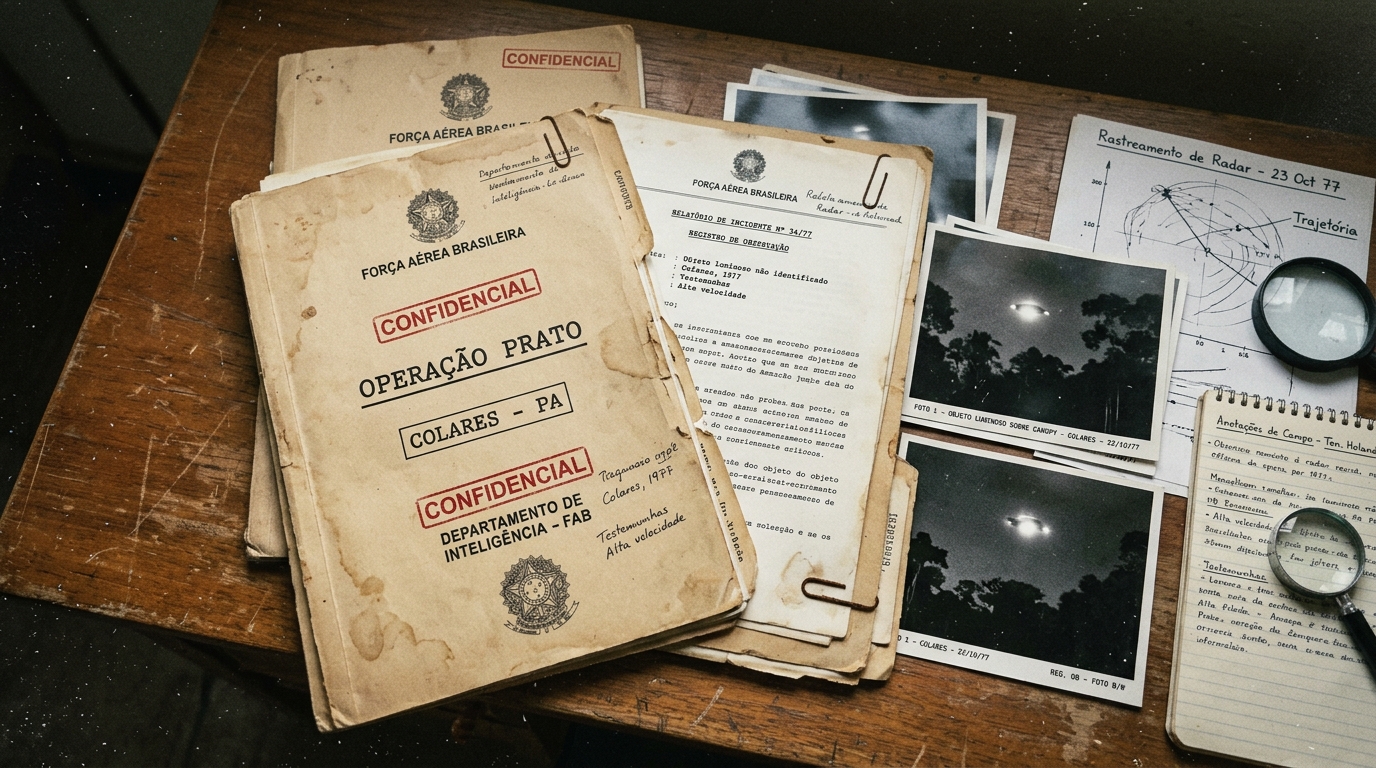
Between September and December 1977, the First Regional Air Command (COMAR I) launched the first official military expedition specifically tasked with recording anomalous aerial incursions.
- Command Under Captain Hollanda: Captain Uyrangê Hollanda led a specialized intelligence detachment to the island of Colares following widespread reports of luminous aerial objects harassing coastal populations.
- Exhaustive Photographic Surveillance: Over four months, Air Force personnel logged hundreds of visual sightings, capturing over 500 photographs and sixteen hours of 8mm/16mm motion picture film documenting luminous maneuvering probes.
- Medical Evidence of Focused Beams: Dr. Wellaide Cecim Carvalho, head of the local public health clinic, treated dozens of victims exhibiting puncture wounds, localized anemia, and acute radiation burns matching the unsealed military health logs.
The 1986 "Official Night of the UFOs": 21 Craft Scrambled Jets
On May 19, 1986, Brazilian airspace experienced an unprecedented radar-visual mass incursion that compelled the Minister of Aeronautics to hold an extraordinary live press conference.
- Multi-State Incursion: Twenty-one luminous spherical objects ranging from 50 to 100 meters in diameter were tracked across São Paulo, Rio de Janeiro, and Goiás by both civilian air traffic and air defense radar.
- Mirage III and F-5E Intercepts: The Brazilian Air Force scrambled five fighter jets from Santa Cruz and Anápolis. Jet pilots reported supersonic acceleration up to Mach 15 and evasive electronic jamming.
- Ministerial Public Confirmation: Aeronautics Minister Brigadier General Octávio Moreira Lima addressed the nation on live television, officially acknowledging that five fighter pilots engaged unidentified vehicles with superior flight performance.
The Varginha Connection: Hospital Testimony & US Transfer Claims
The newly unsealed archive re-examines the January 1996 incident in Minas Gerais that has become the centerpiece of international disclosure efforts.
- Firsthand Medical Statements: Sworn testimony presented before the Senate included physician statements detailing the emergency treatment and quarantine of non-human biological entities at Regional Hospital Humanitas.
- Army Police Firefighter Transport: Military logs confirm the deployment of the Army's ESA (Escola de Sargentos das Armas) under General Sérgio Coelho Lima, cordoning off the Jardim Andere district.
- Allegations of US Custody: Declassified diplomatic cables and witness filings allege that transport crates containing recovered material and biological remains were flown from Campinas Airport via USAF C-17/C-130 transport aircraft into United States research facilities.
Integration with Global Transparency Initiatives
Brazil's aggressive push under its Access to Information Law (LAI) aligns directly with Congressional inquiries and Pentagon PURSUE disclosures in Washington.
- Cross-Border Bilateral Treaties: Brazilian lawmakers have called for formal information-sharing mechanisms between the Brazilian Senate and the U.S. House UAP Caucus.
- Unredacted Military Records: Senate motions demand the complete unsealing of the remaining 10 percent of Operação Prato files historically held under top-secret classification by the Air Force High Command.
- Global Verification: The Brazilian archive provides independent, state-level verification that military forces around the world have tracked identical non-inertial flight dynamics for over half a century.
What to take from it
- Search interest in Brazilian UFO files spiked 250% following high-profile Senate hearings and new National Archive releases.
- Unsealed Air Force files from Operação Prato (1977) document 500+ photographs and motion picture films of anomalous light-emitting craft in Colares.
- Official military records from the 1986 "Official Night of the UFOs" confirm Mirage and F-5 jets chased 21 objects maneuvering up to Mach 15.
- Senate testimonies spotlighted the 1996 Varginha incident, featuring sworn medical affidavits and transport logs.
- Brazil's declassifications establish international corroboration for Pentagon PURSUE records and congressional whistleblower investigations.
Read next
- Bariloche Boeing 727 airport blackout dossier - unsealed international commercial aviation close encounter
- Five Eyes UAP intelligence alliance briefing - multilateral sensor sharing and international tracking
- Cold War Soviet UAP intercepts dossier - declassified international military close encounters
- PURSUE database 480 files audit - the complete federal archive structure and foreign files
Source trail
The strongest reading starts with the primary record, then follows the supporting documents, dates, agency labels, and public statements around it. When commentary or reporting adds context, it is weighed against the source record instead of being treated as the record itself.