Briefing
Congressional UAP Caucus Pushes for Subpoena Select Committee
Executive Summary
Following the 2026 federal midterm elections, the bipartisan coalition of lawmakers championing government UAP transparency has achieved a decisive political victory. Key members of the House UAP Caucus—including Representatives Tim Burchett, Anna Paulina Luna, Eric Burlison, and Jared Moskowitz—successfully defended their congressional seats, preserving the legislative engine driving federal declassification. Emboldened by renewed electoral mandates and growing public impatience over executive stalling, the caucus is formalizing legislation to establish a permanent House Select Committee on UAPs equipped with broad, independent subpoena authority to compel testimony from private aerospace defense contractors and unseal deep-black Special Access Programs.
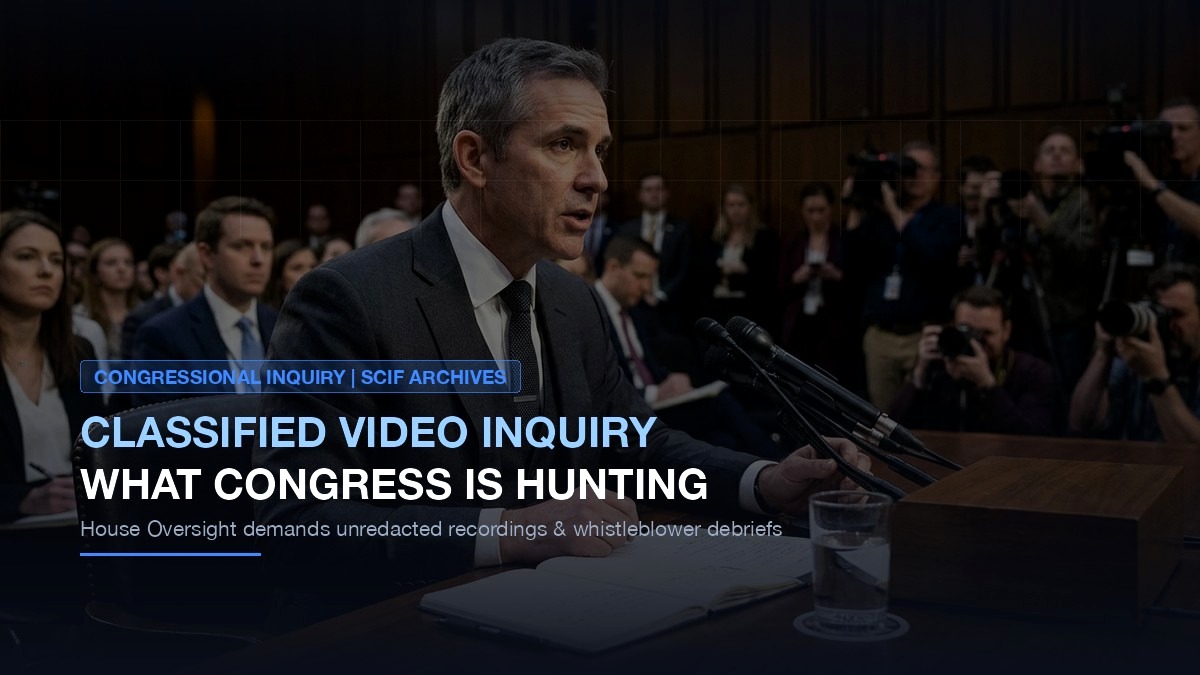
Congressional Oversight: Bipartisan Transparency Hearings
The official player loads only after selection. The source link remains available for direct verification.
What to know
The legislative push comes amid mounting congressional frustration with executive gatekeepers who have repeatedly denied lawmakers access to Sensitive Compartmented Information Facilities (SCIFs) to review sworn whistleblower depositions. By chartering a Select Committee modeled after historical investigative panels, lawmakers aim to bypass Pentagon liaison barriers and hold compulsory public hearings with defense executives under oath.
The Electoral Mandate: Transparency Champions Retain Power
Despite aggressive lobbying by defense industry political action committees, prominent transparency advocates secured re-election across competitive districts.
- Bipartisan Resilience: Lawmakers from both sides of the aisle maintained committee seniority, ensuring uninterrupted continuity in oversight investigations.
- Public Pressure on Defense Conglomerates: Voters across political spectra expressed strong support for unsealing federal spending records tied to covert aerospace research.
- Consolidated Caucus Strategy: Uniting members across the House Oversight, Armed Services, and Intelligence committees into a coordinated voting bloc.
The Select Committee Strategy: Why Subpoena Power Matters
Existing House subcommittees operate under jurisdictional limits that the Pentagon has routinely exploited to delay document production.
- Independent Subpoena Authority: A dedicated Select Committee possesses autonomous authority to issue enforceable subpoenas directly to corporate executives.
- Bypassing Standing Committee Gatekeepers: Preventing committee leadership friendly to defense contractors from burying inquiry requests in legislative limbo.
- Dedicated Investigative Counsel: Hiring specialized security-cleared attorneys to conduct depositions without relying on Pentagon-assigned staff.
Targeting the Defense Contractors: The SCIF Deposition Docket
The primary operational objective of the new Select Committee will be compelling testimony from legacy aerospace corporations.
- Corporate Executive Subpoenas: Demanding sworn appearances from current and former leadership at Lockheed Martin, Northrop Grumman, and Raytheon.
- Auditing Proprietary Non-Disclosure Agreements: Enforcing federal whistleblower statutes that nullify private NDAs when testifying before Congress.
- Unsealing Blind Contract Billings: Partnering with the Government Accountability Office (GAO) to audit historical cost-plus defense contracts dating to 1947.
The Roadmap to PURSUE Tranche 08 and Beyond
The caucus is utilizing legislative deadlines in the FY 2026 defense bill to force rolling declassifications onto War.gov/UFO.
- Enforcing Section 1683 Deadlines: Holding public contempt hearings if the Department of War fails to release mandated NORAD and space intercept files.
- Televised Prime-Time Depositions: Scheduling open, televised hearings featuring corroborated military and intelligence whistleblowers.
- Securing Permanent Statutory Records Reform: Enacting comprehensive legislation modeled after the JFK Records Act to permanently unseal all historical government files.
What to take from it
- The bipartisan House UAP Caucus retained key seats in the 2026 elections, securing a renewed mandate for federal transparency.
- Lawmakers are drafting legislation to create a dedicated House Select Committee with independent subpoena authority over defense contractors.
- The committee will target proprietary corporate non-disclosure agreements and demand sworn testimony from aerospace executives.
- Congressional pressure is accelerating statutory declassification deadlines for upcoming PURSUE releases on War.gov/UFO.
Read next
- House UAP Caucus contractor subpoenas briefing - lawmakers drafting subpoenas for aerospace defense CEOs
- FY 2026 NDAA NORAD mandate - statutory requirements compelling multi-domain radar unsealings
- David Grusch whistleblower claims briefing - sworn congressional testimony regarding legacy crash-retrieval programs
- PURSUE Release 07 master hub - complete directory of the latest 28 declassified federal records
Source trail
The strongest reading starts with the primary record, then follows the supporting documents, dates, agency labels, and public statements around it. When commentary or reporting adds context, it is weighed against the source record instead of being treated as the record itself.