Briefing
SCIF Standoff: House UAP Caucus Drafts Subpoenas for Defense Aerospace CEOs
Executive Summary
Tensions between Capitol Hill and private aerospace defense conglomerates have reached a historic flashpoint. Members of the bipartisan House UAP Caucus—led by Representatives Tim Burchett, Anna Paulina Luna, Eric Burlison, and Jared Moskowitz—have formalized draft subpoenas targeting top executives at major defense corporations, including Lockheed Martin, Northrop Grumman, and Raytheon. Citing months of executive branch obstruction and denied access to Sensitive Compartmented Information Facilities (SCIFs), lawmakers are exercising compulsory legal process to force sworn public depositions regarding alleged unacknowledged Special Access Programs (USAPs) and legacy material holdings.
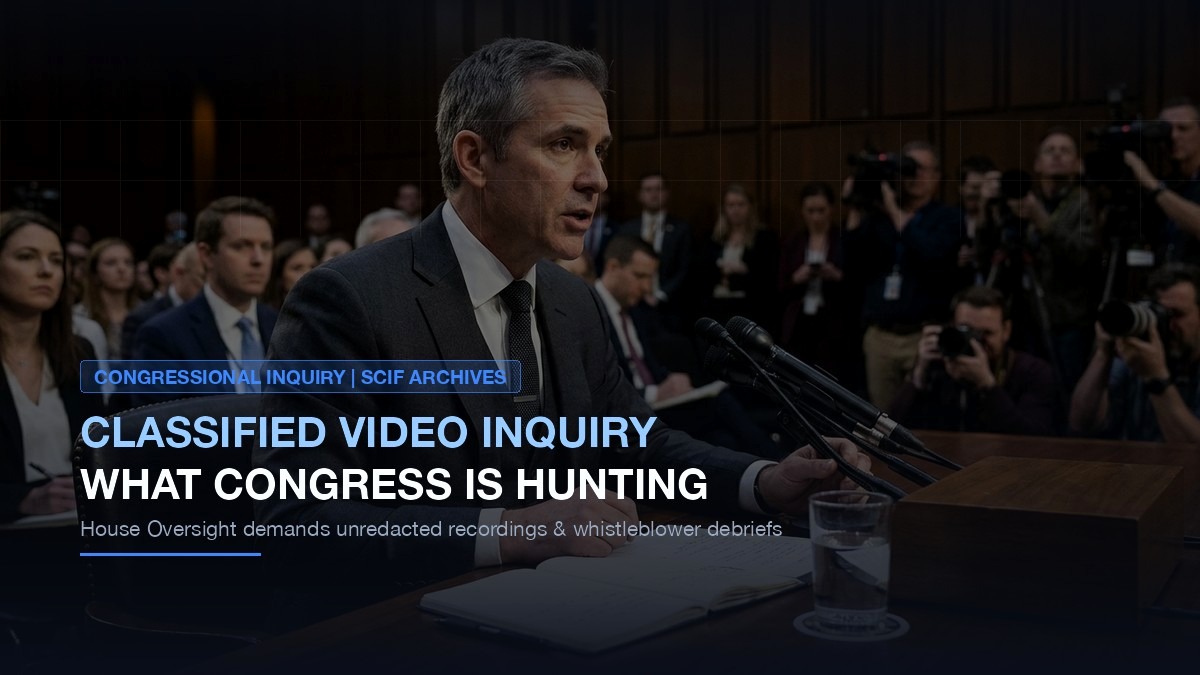
Congressional Oversight & Whistleblower Investigations
The official player loads only after selection. The source link remains available for direct verification.
What to know
The subpoena drafts follow months of behind-the-scenes negotiations where defense contractor legal teams refused voluntary congressional interviews, claiming binding Department of Defense Non-Disclosure Agreements (NDAs). Lawmakers counter that congressional oversight authority under Article I of the Constitution supersedes executive classification directives, particularly where federal funds were allocated outside statutory oversight.
The Subpoena Escalation: Bypassing Pentagon Gatekeepers
Rather than appealing to the Pentagon Office of the Secretary of Defense or AARO, lawmakers are utilizing House Oversight Committee rules to issue subpoenas directly to corporate boardrooms.
- Direct Corporate Subpoenas: Compelling chief executive officers and chief technology officers to produce internal documents and appear for recorded depositions.
- Evading Bureaucratic Stalling: Circumventing Department of Defense legislative liaison offices that have historically delayed congressional inquiry requests.
- Contempt of Congress Warnings: Committee leadership has signaled that non-compliant executives will face formal contempt citations on the House floor.
Targeting the Big Three: Lockheed Martin, Raytheon, and Northrop Grumman
Congressional investigators have identified specific aerospace facilities and advanced development divisions as primary targets for document preservation orders.
- Skunk Works Archives: Demanding complete material acquisition logs and classified program manifests from Lockheed Martin's advanced development division.
- Radiometric & Sensor Telemetry: Requesting Raytheon sensor calibrations, radar cross-section studies, and full-motion video feeds captured by defense assets.
- Special Access Program Contracts: Unsealing historical cost-plus defense contracts from 1954 to the present that operated under blind billing codes.
Non-Disclosure Agreements vs. Congressional Oversight Inquiries
The core legal battlefield centers on corporate NDAs executed between private contractors and military intelligence agencies.
- Whistleblower Protection Act Supremacy: Federal statutes explicitly state that no non-disclosure agreement can prevent an employee from communicating directly with Congress.
- Criminal Penalties for Retaliation: Lawmakers have placed corporate human resources departments on formal notice regarding threats to revoke clearances or terminate employees.
- Safe-Harbor Depositions: Offering witnesses legally binding immunity and secure deposition venues outside corporate surveillance.
The SCIF Deadlock: Demanding Unclassified Sworn Public Hearings
Frustrated by repeated Pentagon efforts to sanitize public hearings by forcing critical discussions behind closed SCIF doors, lawmakers are demanding public transparency.
- Declassification on the Floor: Utilizing constitutional Speech or Debate Clause protections to read classified findings directly into the public Congressional Record if unsealing is blocked.
- Televised Committee Hearings: Scheduling open, prime-time investigative hearings with subpoenaed aerospace executives and corroborated whistleblowers.
- Cross-Examination of AARO Leadership: Concurrently summoning AARO officials to confront documented contradictions between public statements and classified whistleblower files.
The Eminent Domain Precedent: Asserting Federal Control Over Crash Records
The legislative effort is paired with renewed legislative amendments designed to reclaim government ownership over any off-world or non-human technological assets.
- Statutory Eminent Domain: Enforcing statutory provisions asserting that all technological artifacts originating from non-human intelligence belong to the public domain.
- Immediate Transfer to NARA: Requiring all historical contractor files concerning retrieved anomalous craft to be cataloged at the National Archives.
- Financial Clawbacks: Proposing budgetary clawbacks for any public defense funding diverted to illicit or unmonitored private aerospace research projects.
What to take from it
- The bipartisan House UAP Caucus has drafted compulsory subpoenas targeting chief executives at Lockheed Martin, Raytheon, and Northrop Grumman.
- Lawmakers are bypassing Pentagon gatekeepers to demand sworn testimony regarding alleged legacy crash-retrieval and reverse-engineering programs.
- Congressional leaders emphasize that Article I oversight authority supersedes executive non-disclosure agreements and classification restrictions.
- The escalation follows repeated SCIF denials and aims to compel public, unclassified hearings under oath.
Read next
- Jay Stratton Lockheed craft briefing - investigation of aerospace contractor holdings and agency transfers
- David Grusch whistleblower claims - sworn testimony regarding private contractor crash-retrieval programs
- Immaculate Constellation whistleblower dossier - unacknowledged Special Access Program documentation
- Pentagon Tranche 08 preview - analysis of queued declassifications and scheduled releases
Source trail
The strongest reading starts with the primary record, then follows the supporting documents, dates, agency labels, and public statements around it. When commentary or reporting adds context, it is weighed against the source record instead of being treated as the record itself.