Briefing
Guam 1956 UFO Dogfight: Unsealed Air Force Jet Intercept
Executive Summary
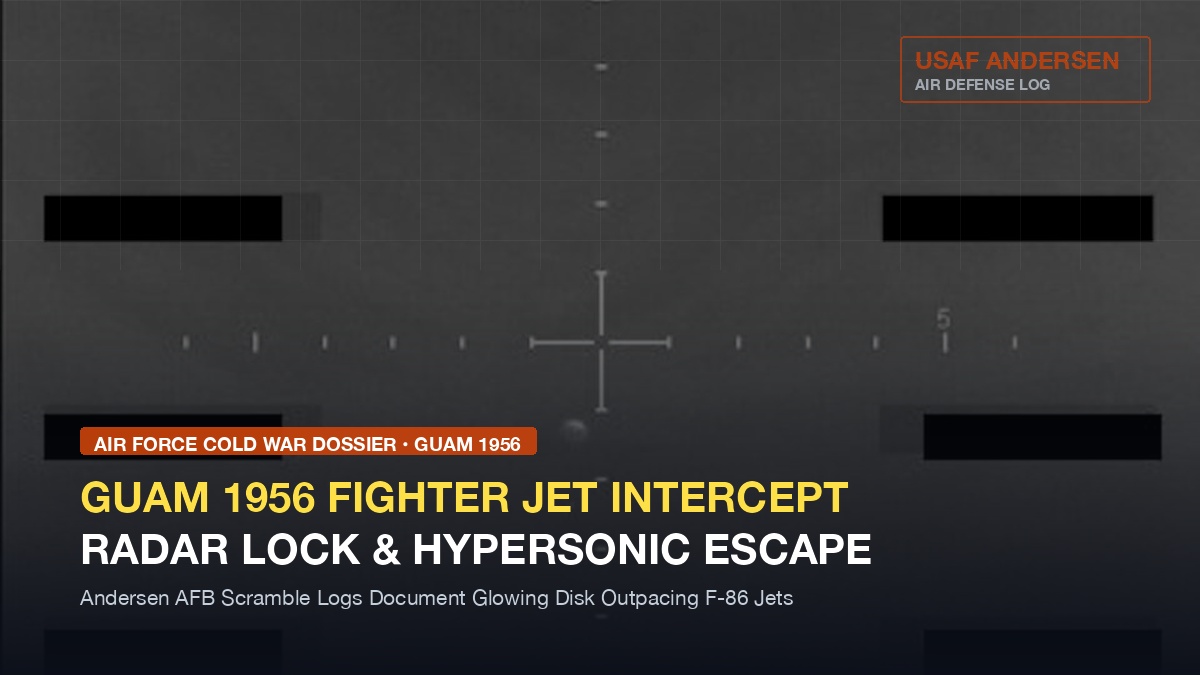
In a newly unsealed Cold War case study resurfacing in defense historical archives, an official Air Technical Intelligence Center (ATIC) case file documents a dramatic 1956 air defense scramble over the strategic Pacific outpost of Guam. Stationed at Andersen Air Force Base, U.S. Air Force jet interceptors were scrambled to intercept an unidentified glowing object detected by ground radar. When pilots attempted an airborne intercept, the target engaged in responsive maneuvers, out-climbed the fighters, and departed at speeds calculated to exceed Mach 3.
The Andersen Air Force Base radar scramble and the 1956 supersonic intercept
Guam has served as America’s premier Pacific fortress and atomic bomber staging hub since World War II. During the height of 1950s Cold War nuclear readiness, any unauthorized penetration of Andersen AFB airspace triggered immediate alert scrambles. The unsealed Guam file represents one of the cleanest "radar-visual" cases in the Air Force’s historical investigative files.
The Scramble: Ground Radar Alerts at Andersen AFB
On a clear afternoon in 1956, the 41st Air Division’s ground-controlled intercept (GCI) radar station tracked a high-speed blip tracking southwest toward the naval harbor.
- Radar controllers observed the object decelerate abruptly from high cruising speed to a complete hover over the northern tip of the island.
- With no scheduled civilian traffic and no commercial transponder handshake, base commanders scrambled an armed jet interceptor flight to achieve visual identification.
- Ground radar operators maintained an unbroken track while guiding the scrambled pilots directly toward the target coordinates.
Cockpit Visual Contact: A Glowing Disk With No Wings
As the flight leader closed within three nautical miles of the radar-designated vector, both the pilot and radar intercept officer achieved clear visual contact.
- The pilots described the object as a brilliant, glowing, disc-like structure with a metallic silver center and an iridescent perimeter halo.
- The object possessed no visible cockpit canopy, wings, horizontal stabilizers, or jet intake/exhaust apertures.
- When the interceptor closed to within firing range for camera guns, the object rotated on its axis and accelerated straight up through cloud layers at unprecedented vertical velocity.
Radar Telemetry Analysis and ATIC Evaluation
Upon landing, flight logs, radar scope photos, and pilot debriefs were immediately classified and forwarded to Wright-Patterson Air Force Base.
- Calculated speeds during the object’s vertical escape exceeded 2,400 miles per hour (Mach 3+), far surpassing the top speed of operational 1956 jet aircraft.
- ATIC intelligence analysts systematically ruled out weather balloons, astronomical phenomena, and temperature inversions due to the simultaneous visual and dual-radar tracks.
- The incident was formally categorized by Project Blue Book investigators under the "Unknown" classification category.
Significance for Modern Trans-Pacific UAP Research
Historical military files like the 1956 Guam case are vital for evaluating modern aerospace safety and defense intelligence claims.
- Consistent Performance Metrics: The instant acceleration, absence of aerodynamic wings, and hovering capability documented in 1956 match 2026 defense encounter files.
- Historical Defense Vulnerability: Strategic installations in the Pacific have experienced persistent aerial surveillance by unknown vehicles for over seventy years.
- Primary Source Reliability: The case demonstrates that the Air Force maintained rigorous scientific and radar verification standards before cases were publicized or debunked.
Key findings from the declassified 1956 Guam jet dogfight file
- Declassified Air Force files document a 1956 jet interceptor scramble against a glowing disc-shaped object over Andersen AFB, Guam.
- The encounter was verified simultaneously by ground-controlled radar, airborne radar, and visual confirmation from multiple pilots.
- The craft demonstrated responsive tactical behavior, out-climbing interceptors at calculated speeds exceeding Mach 3.
- Project Blue Book analysts formally logged the encounter as an unexplained "Unknown," ruling out balloons, meteors, and radar anomalies.
Read next
- Project Blue Book archive briefing - analysis of the 701 officially unexplained Air Force cases
- Catalina Island UFO files - another prominent 1950s naval/island aerial case file
- Colonel Howard McCoy dossier - the origins of Air Technical Intelligence Center investigations
- Global UAP incident tracker - search military encounter cases across decades
How to analyze Cold War ground-controlled intercept (GCI) radar logs
The strongest reading starts with the primary record, then follows the supporting documents, dates, agency labels, and public statements around it. When commentary or reporting adds context, it is weighed against the source record instead of being treated as the record itself.