Briefing
RAF Typhoon Near-Misses: Declassified Jet Encounter Files
Executive Summary
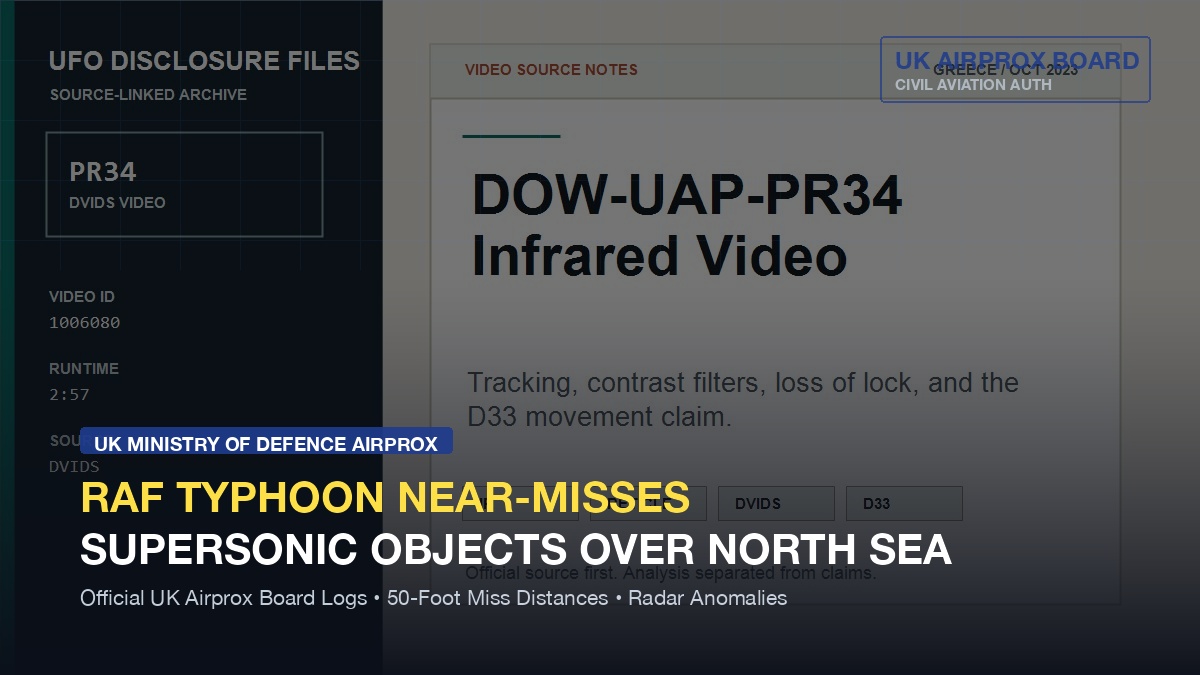
Newly declassified air safety records from the UK Airprox Board (UKAB) and the Ministry of Defence (MOD) reveal a series of alarming close-proximity aerial encounters between Royal Air Force (RAF) Eurofighter Typhoon interceptors and unidentified high-speed objects over the North Sea. In multiple cases, frontline combat pilots operating out of RAF Coningsby and RAF Lossiemouth reported wingless, cylindrical and disc-shaped objects passing within 50 feet of aircraft cockpits at closing speeds calculated to exceed 1,000 knots.
What the official UK Airprox Board jet near-miss reports document
The UK Airprox Board is the official body responsible for investigating air proximity events to enhance flight safety across civil and military aviation. Unlike anonymous UFO sightings, Airprox reports are filed under strict professional duty by operational fast-jet pilots and evaluated by a joint military-civilian board of aviation inspectors.
The Airprox Reports: Categorized as "Risk of Collision"
Several unsealed incident reports were formally categorized by the board under Category A (defined as "an actual risk of collision existed").
- In one prominent case, an RAF Typhoon pilot flying at 28,000 feet during a tactical intercept exercise reported a dark, wingless, matte-grey object pass down the starboard side of the cockpit with a miss distance estimated at 50 feet.
- The pilot noted in the formal statement: "The object was completely non-aerodynamic, possessing no wings, tail fins, rotor blades, or visible exhaust plume, yet moving at high subsonic velocity."
- The incident happened so rapidly that cockpit collision avoidance alarms (TCAS) did not trigger, and the pilot had no time to take manual evasive action.
Primary Radar Telemetry vs. Transponder Silence
The official board summaries cross-referenced the cockpit debriefs with ground-based military air defense radars stationed along the eastern British coastline.
- Military air traffic controllers at RAF(U) Swanwick and coastal radar sites confirmed intermittent primary radar returns at the reported incident coordinates.
- The target was broadcasting zero transponder Mode 3/A or Mode S signals, confirming it was an uncoordinated, unauthorized intrusion into active military training airspace.
- Military radar sweeps tracked the contact accelerating eastward toward international waters at speeds exceeding the maximum sprint capability of commercial consumer drones.
The "Drone" Label: Why Military Pilots Push Back
In many official summaries, investigative panels routinely conclude that sightings are "probably a drone" or "unauthorized UAV," but aviation experts note serious technical contradictions.
- Altitude Impossibility: The majority of commercial consumer quadcopters are electronically geofenced and aerodynamically incapable of operating at 28,000 to 35,000 feet in freezing sub-zero jet streams.
- Speed Discrepancy: Consumer drones fly at 30 to 60 knots; the objects logged in RAF Airprox reports were maintaining closing velocities with Mach 1.5 jet fighters.
- Battery and Endurance: Operating dozens of miles offshore in hostile North Sea marine environments requires advanced military-grade propulsion far beyond hobbyist hardware.
Implications for Global Defense Airspace Security
The unsealed RAF Airprox dossiers demonstrate that unauthorized anomalous craft in military training airspace are not an isolated American phenomenon.
- International Consistency: The physical descriptions (wingless cylinders, metallic spheres, high closing speeds) mirror reports logged by US Navy aviators on the Atlantic and Pacific coasts.
- Severe Aviation Hazard: Regardless of origin, untransponded objects operating in active flight corridors represent an urgent mid-air collision hazard for defense and commercial aviators.
- Call for Standardized Reporting: British aviation safety groups are pushing for standardized civil-military UAP reporting protocols similar to those recently adopted by the U.S. Federal Aviation Administration.
Key takeaways from the RAF Typhoon supersonic object debriefs
- Declassified UK Airprox Board files document RAF Typhoon pilots narrowly missing wingless, high-speed objects within 50 feet.
- The encounters were categorized under Category A (actual risk of collision) over the North Sea.
- Military coastal radar verified primary target returns operating without transponders at altitudes up to 28,000 feet.
- Operating altitudes and speeds conclusively rule out hobbyist consumer drones, pointing to advanced defense probes or unexplained UAP.
Read next
- FAA radar secrets briefing - how radar software filters untransponded targets in commercial airspace
- Guam 1956 jet dogfight briefing - historical comparison of fighter jet scrambles against anomalous targets
- PURSUE Release 07 black triangle briefing - multi-agency radar and flight telemetry records
- Global incident tracker - search military aviation near-miss encounters worldwide
How to evaluate civil aviation airprox reports alongside military radar records
The strongest reading starts with the primary record, then follows the supporting documents, dates, agency labels, and public statements around it. When commentary or reporting adds context, it is weighed against the source record instead of being treated as the record itself.